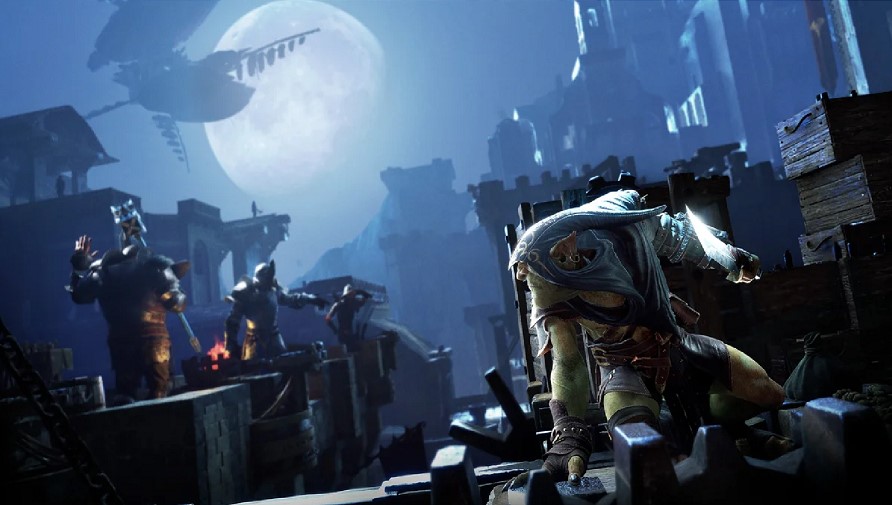
Nine years later, the industry’s most caustic goblin returns, but it seems he’s forgotten to check the calendar. We played the demo of Styx: Blades of Greed and felt like we’d stepped into a time machine: it’s the same hardcore stealth game from the mid-2010s. Is that a bad thing? It depends on how much you missed games that didn’t forgive you for mistakes.
One of a kind
The stealth adventure series featuring a one-of-a-kind talking goblin named Styx has always existed on the fringes of the industry. It never embraced technology, offered no significant innovations, or attempted to be seen as a “revolution”—and existed for a small circle of people willing to embrace it, pros and cons alike. It seems that won’t change: neither the developers nor the caustic green-skinned trickster seem to be moving forward.
Two hours spent with the demo immediately reveal the essence of the project. The game deliberately adheres to an old formula, reproducing familiar tropes and mechanics rather than developing them further. This isn’t a death sentence, but it’s a reason to take a closer look at the details—and that’s exactly what we’ll do now.
According to the developers, Blades of Greed is intended to connect the previous Styx games with the older Of Orcs and Men. The plot is told through a frame structure: against the backdrop of war, Styx recounts his story to a group of young recruits, explaining how he ended up where he is today.

The story almost immediately transitions into a flashback, which takes us to the final seconds of the final cutscene of Styx: Shards of Darkness – aboard the zeppelin, where the fight between Styx and Jaark is interrupted by the appearance of the golem.
The connection to the previous game is direct, but perfunctory. Who these characters are and what significance all of this has for the world—the answers to these questions are either implied or deferred. If you haven’t played the previous games, the game won’t bother explaining.
Against this backdrop, the developers’ claims that knowledge of previous games is unnecessary sound entirely sincere—but not for the reasons one might hope. While they’re formally talking about preparing for a major war and weakening the human side, the greedy goblin’s personal motivation remains extremely simple: to exploit the situation to his own advantage.
Styx assembles a team, travels between locations, and absorbs quartz—a rare and dangerous magical resource that becomes the center of the conflict. Ultimately, the story seems even simpler than the sequel, which was criticized for the same thing at the time. I’m not rushing to draw any final conclusions, but the alarm bells have already rung. Let’s acknowledge this and acknowledge the obvious: the series is primarily valued for its gameplay. We’ll discuss that further.

Player and space
The demo offers two story chapters. The first is a linear prologue with a simple objective: climb inside a golem and disable it to escape the dark elf city of Korrangar. As the level progresses, the game gradually introduces basic movement mechanics—climbing, dashing, sliding, double jumping, and other parkour elements—that underpin all subsequent gameplay. The prologue leaves no room for improvisation and serves as a tutorial.
Things get noticeably more interesting from here. After escaping, the zeppelin crashes into the Wall—a cyclopean human fortress city. Here, Styx must pull off a daring theft of a new aircraft and, along the way, assemble a crew for the journey ahead. At this point, Blades of Greed gives the player their first taste of the core gameplay loop and stops leading them by the hand.
The Wall isn’t just a city, but a full-fledged vertical labyrinth. Docks, taverns, warehouses, dining halls, living quarters, and utility areas form a multi-level space that feels natural, though primarily designed as a playground, challenging our goblin.

The location of the current target—be it a character or an object—is only symbolically indicated: we see the search area, but we don’t know its exact location. Once given a landmark, the player must explore the space independently, decipher the level logic, and figure out how to reach the goal. As a result, every meter here becomes a small puzzle, requiring planning, attention, and patience.
At first, this can be disorienting. The locations are deliberately devoid of bright visual accents, eye-catching landmarks, and obvious “cues” like yellow paint. The boundaries between interactive elements and blank scenery aren’t always immediately apparent—this takes some getting used to, but it also enhances immersion. Over time, the space becomes more legible, and navigation becomes easier. It’s still no cakewalk, however: each location is teeming with guards, and stealth comes into play here.
The basic stealth is extremely classic. Styx skulks in the shadows, hides in nooks and closets, sneaks up on his victims from behind, above, or below—jumping out of a sewer grate and draining their blood with a single, precise strike—or simply carefully evades security without making contact.

At the same time, the guards are alert enough to keep everyone on edge. They patrol the area, respond to noise, raise the alarm when bodies are found, communicate among themselves, readily call for backup, and begin combing the area at the slightest suspicion.
If the guards see Styx going into the sewers, they’ll unleash poisonous gas without a second thought, forcing him to change his route immediately. This doesn’t make the enemy smart in the classic sense—if you hide in a safe place and wait it out, they’ll forget about you—but it does force you to play carefully and not rely on luck.
Therefore, it’s important to monitor the noise level using the indicator, the direction of guards’ gaze through the “amber gaze” (the local equivalent of witcher senses), dim light sources, and consider the type of surface. Footsteps on carpet and other soft materials are muffled—this is critical, for example, if you’re sneaking past a sleeping guard. And, of course, don’t forget to hide bodies or hide yourself in cabinets, chests, or by pressing against a wall, disappearing into the shadows.
When that’s not enough, the game offers a whole host of ways to intervene. The most obvious is distraction. You can throw bottles to create noise, whistle to lure guards to a specific location, or use darts to silently eliminate targets from a distance.
More creative ways to deal with threats are also found in the locations. In some cases, you can drop a chandelier on the head of an unwary guard, in others, push an enemy from a height, and sometimes, clear a path without direct contact at all. For example, to defeat larger enemies, you can first poison the water, weakening them, and then finish them off with a familiar stealth strike.

New tricks of the old goblin
The game doesn’t force a single playstyle. I methodically cleared some sections, while others I navigated without bothering anyone at all. Quicksaving is available with a single button press when not in an alert state—this certainly encourages abuse, but it also encourages experimentation, allowing you to try different approaches without harsh punishment for mistakes.
To achieve this, in addition to basic abilities, Styx’s arsenal includes magical abilities and gadgets that significantly expand his tactical options. These are divided into three branches.
The first are amber skills, which consume the corresponding meter. These are Styx’s classic abilities, familiar from previous games: invisibility, clones, amber gaze, and so on. Invisibility is available from the start, and in the demo, I only managed to unlock the basic clone version, but even this set was enough to help out in critical situations.
With further development, Amber Sight will allow you to see enemies through walls, clones can be trained to eliminate enemies from ambush and immediately hide their bodies, and invisibility will work indefinitely as long as Styx remains stationary. This will allow you to set up ambushes literally out of nowhere. You won’t be able to test all of this in practice in the demo, but the potential of these skills is clear.
There are also some questionable decisions in this branch. For example, the ability to automatically hide a body after an ambush kill is developed separately—for the clone and for Styx himself. This separation seems illogical and feels more like an artificial limitation.

The second skill tree is linked to quartz and remains as promised in the demo. Quartz serves as a separate resource here, enabling more aggressive and effective abilities, which, according to the developers, should significantly expand Styx’s capabilities beyond the usual stealth.
These include mind control, which allows the player to temporarily subjugate enemies; time warping, which slows down the world around them; a kinetic strike that knocks back enemies and objects; and “goblin reflexes,” which automatically evade attacks and projectiles.
All of these abilities have their own talents and, on paper, look potentially interesting—especially based on experience with similar abilities in other games like Dishonored. However, it’s impossible to gauge how much the game will encourage you to use them in the demo.
The third branch is responsible for consumables, gadgets, and quality of life improvements. Here, you can craft acid flasks and acid mines, which allow you to eliminate a target and immediately dissolve their corpse—useful in situations where you don’t have time to mess around with bodies. This branch also improves potion effects for amber skills, consumable carry capacity, lockpicking speed, and other useful tweaks.
They don’t seem critically important, but they significantly reduce the number of situations where one mistake ends in instant death, especially considering that even on “normal” difficulty, Styx’s survivability after being detected by guards is extremely low.

As before, Styx is poorly suited to direct combat. Technically, he has dodges in various directions—they can even be timed to coincide with an enemy’s swing, creating a window for an instant kill. Thanks to this, a single enemy can still be dealt with somewhat. But if two enemies come at you—and from different directions, no less—the game will quickly remind you that you didn’t come here to fight.
Well, you don’t want to. Combat here is accompanied by jerky animations, crooked hitboxes, and other “pleasures” that clearly suggest that close combat isn’t so much an option as an emergency and a punishment for failure.
So, when an enemy, for example, drags a goblin out of cover by the scruff of the neck, you’re left with only two options: either run immediately or stand still and wait to die. Fortunately, this only takes a couple of seconds: you can simply restart from your last save—thankfully, even without manual saves, they’re quite frequent here.
Perhaps with the discovery of Quartz abilities, it will be easier to find a way out of such situations: after all, offensive spells, talents that increase the chance of automatic dodging, other bonuses, and runes will be added to the arsenal. But for now, we have what we have.

Risk zones and comfort limits
This is a good time to discuss the most controversial aspects and risky areas. On the one hand, the developers deserve praise for their location design and the level of freedom. The level design is creative and confidently supports a variety of playstyles, from careful stealth to methodical clearing. Verticality already plays a key role in the demo, and in the full game, they promise to expand it with the grappling hook and glider, potentially opening up the environments even further.
On the other hand, even the demo reveals that this structure has limitations. Apparently, there will only be three zones globally, and despite the Wall’s scale, you’ll likely have to return to familiar areas more than once. This was a weakness of the sequel, and there’s a risk that over the long haul, reusing the same locations will become tiresome—especially if the variety of objectives doesn’t compensate for the repetitive use of the same set pieces.
But the most disturbing aspect is the technical implementation. Blades of Greed greets you with a strange, noisy image: the rain effects in the prologue saturate the image with mud even in native resolution and with DLSS enabled. This continues even in the “performance” mode, where the image paradoxically becomes cleaner. In other weather conditions, high settings look noticeably better, but the initial impression is already spoiled—and it only gets worse.

The game overall looks visually dated—not in age, but in execution. Despite Unreal Engine 5 under the hood, lighting and shadows are almost static and flat, scenes lack depth, and the lack of distinct volumetric shading only emphasizes the blurriness of textures.
This could be chalked up to a deliberate design decision—that light and shadow are part of the gameplay logic—but that’s a weak excuse. Shards of Darkness, nine years old, managed to look more expressive and atmospheric in Unreal Engine 4.
Perhaps the reason lies in optimization. The demo easily maintains around 100 fps on an RTX 4070 Super at 1440p with DLSS in “quality” mode, and it seems like Lumen and Nanite were deliberately omitted to avoid a performance hit. But what if the full version actually enables all the necessary options? That’s concerning.
There are also plenty of minor technical issues that don’t break the gameplay but are constantly annoying. Textures occasionally load before your eyes, especially during cutscenes with abrupt transitions, when it seems the scene simply doesn’t have time to load. The cutscenes themselves are often choppy, accompanied by micro-freezes and flickering surfaces. This seems to be a chronic problem for Cyanide, as cutscenes have been a problem before.
The game itself breaks immersion when Styxx comments on what’s happening at the wrong moment. For example, after a silent kill, you put a guard’s body in a chest, and Styx …
This isn’t exactly a set of issues that make you want to give up on the game, but it’s a constant reminder that the game is still holding together by a thread.

Verdict
Individually, all these minor issues are easily chalked up to a limited budget, the series’ unique features, or the usual “they’ll polish it up later”—whatever suits you best. But together, they add up to the feeling I mentioned at the very beginning of this article. Styx: Blades of Greed doesn’t feel like a step forward or an attempt to reinvent the series. It’s treading water: replicating a familiar formula, repackaging old ideas, making minor cosmetic improvements, making a few new promises, and then repeating the same old tricks.
That said, I can’t say I was bored. On the contrary, the demo does a great job of keeping you interested thanks to its solid level design, verticality, and freedom of decision. Styx still works well as a stealth puzzler that rewards observation and creativity.
But beyond these strengths, it quickly becomes apparent that the game offers almost nothing fundamentally new—mechanically, structurally, or technically. Over the long term, this formula risks collapsing from monotony.
Perhaps the reason lies deeper: the series remains almost unique in the modern industry as an example of a relatively hardcore stealth game without direct competitors—and therefore without any real incentive for development.
Ultimately, the conclusions are simple. If you have fond feelings for the previous games in the series and haven’t grown tired of them, Blades of Greed is a safe bet. If Styx’s previous adventures didn’t grab your attention, this installment is unlikely to change anything. This is a project strictly for its audience—those who miss Styx and his sarcastic grumbling, and are willing to overlook Cyanide’s shortcomings and lazy approach.