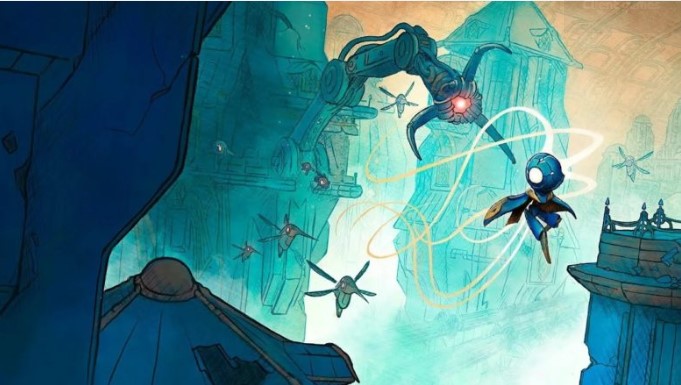
MIO: Memories in Orbit is a new platformer from the young French indie studio Douze Dixièmes. It’s a captivating, melancholy, and moderately challenging Metroidvania, with a sense of coherence and a meticulous, almost intimate, attention to detail. I’ll go into more detail in the review.
- Developer: Douze Dixièmes
- Publisher: Focus Entertainment
- Platforms: PC, Xbox Series X|S, PlayStation 5 , Nintendo Switch 2
- Release date: January 20 , 2026
The player follows the story of an android named MIO, who awakens on a gigantic technological ark drifting through space . The ship is abandoned, its systems are broken, the machines have taken on a life of their own, not always friendly, and the hero must recover his memory, understand the structure of this world, and understand what exactly happened here and where it’s all heading.
The first thing that immediately sets MIO: Memories in Orbit apart from other Metroidvanias is its thoughtful artistic language. The visuals don’t descend into the grotesque and dark, contoured expression of Hollow Knight, nor do they overwhelm the eye with the fairytale brightness of Ori. It’s somewhere in between in terms of the softness of the palette, but with a distinctly “hand-drawn” character. The textures in the game look as if they were drawn with pencil or pastel: the contours are slightly jagged, the shadows are shaded. The project is composed of lines and soft colors, like illustrations in an album, yet it boasts impeccable visual readability—a pleasure to behold.

The experience is enhanced by the equally pleasing sound design. A soft, slightly detached cosmic theme dominates the game, with the exception of particularly tense moments like boss fights. The music creates the right emotional atmosphere, conveying an atmosphere of loneliness and slow exploration. In some locations, it’s even reminiscent of the space motifs from old Soviet cartoons . The sound effects blend seamlessly into all of this. For the first time in my memory, I’ve played a naturally tense Metroidvania with such a melancholic feel.
In terms of controls, MIO: Memories in Orbit follows the classic canons of the genre. The developers didn’t even include a full tutorial (at least not in the pre-release version), and if this remains the case, I see this as a distinct philosophy – the game assumes the player is familiar with the basic “grammar” of platformers . See a chasm? Jump. Realize the distance is too great? Try a double jump, and spamming the familiar attack button initiates a combo. Incidentally, you can perform a series of moves in mid-air, hovering near an enemy for a while.

The combat system is designed to encourage active positioning and vertical combat. Unlike some popular Metroid games, where enemies simply charge forward, here they can be held back with combo attacks and knocked back. Furthermore, MIOs have a very small default health pool—just two hit points. Mistakes are punished harshly, especially early on, before access to significant upgrades. However, an important detail significantly alleviates the overall tension: physical contact with enemies doesn’t cause damage. Damage is inflicted only by their active attacks. This allows you to get up close, jump over large enemies, and experiment with distance and timing without fear of losing health due to accidental contact. The same rule applies in boss battles , allowing you to focus on reading their attacks and patterns.

By defeating enemies, MIO collects mother-of-pearl, a resource that serves both as currency and the foundation of the survival system . It is used to restore protective armor (i.e., health points), for trading, and for story-based quests, such as refilling a dried-up reservoir.
The system for losing and saving nacre is interesting and not as harsh as it might seem at first glance. Upon death, the accumulated resource disappears and cannot be recovered at the site of death, which is initially painful. However, it is not completely lost; rather, it moves through the world’s network nodes to a central safe zone, where it gradually fills Nia’s pond. Once this pond is filled, the player gains access to the world map, significantly facilitating navigation. Furthermore, crystallizers are found throughout the world—devices that allow nacre to be condensed into crystals, thereby “insuring” it against loss. This creates an interesting balance between risk and preparation.

Character progression is tied to a modifier system, accessible in the Nexus. All upgrades are installed in a so-called distribution matrix with a limited number of energy slots. Each modifier takes up a certain number of these slots, and by default there are only twenty-five. Upgrades range from purely utilitarian, such as displaying health (without the appropriate module, the HP indicator is simply absent), to combat, defensive, and economic ones. Some enhance combos, others increase the amount of Mother-of-Pearl dropped by enemies, and still others allow free repairs to protective armor in special bowls. Serious defensive modules can occupy almost the entire available matrix, forcing players to make choices and tailor their configuration to their playstyle. Expanding the matrix is possible, but requires rare resources—old cores, which must be found in the world and brought to Halin, the owner of the restoration shop.

There are other permanent upgrades, too. For example, you can collect Guardian Tendrils, which permanently increase your character’s damage. And the system for acquiring key abilities, such as the ability to pull yourself up, latch onto, and pull yourself to special crystals, is unlocked by immersing yourself in MIO’s digital world. You’ll find yourself in mini-levels, designed as abstract, geometric platforming challenges, where new abilities are immediately put to the test. Incidentally, MIO is silent in the main world, but in the inner world, she’s accompanied by a haunting voice, adding another layer to the narrative and subtly expanding our understanding of the android’s nature.
Exploration of the world is based on the principle of gradual mastery through trial and error. MIO interacts with the environment using thin appendages on her head, known locally as antennae. She uses them to press buttons and attack enemies. Similarly, the player learns the dangers and rules of the world by touch. The ship doesn’t resemble a spacecraft; it looks like the ruins of an entire ecosystem from the distant future , where the organic and artificial have intertwined but lost their harmony. In terms of level design, the game follows the classic logic of Metroidvania: returning to familiar areas with new abilities reveals shortcuts , secrets, and alternative routes, and the world map gradually acquires coherence and internal logic.

The lore is revealed fragmentarily, through dialogues with peaceful inhabitants and the wanderer’s diaries. These entries gradually piece together a picture of humanity’s space expedition and the fate of the ark that became the home of the MIO. The game leaves considerable room for interpretation and gradual understanding.
It’s nice that MIO: Memories in Orbit becomes noticeably more friendly as the player progresses. Having acquired the ability to latch onto enemies and other upgrades, having learned to accumulate nacre, and having expanded the modifier matrix, the player no longer feels the constant pressure of the environment. Returning to the point of death is faster, enemies are killed more effectively, and the risk of losing all accumulated resources is significantly reduced. Compared to, say, Hollow Knight, MIO feels much less merciless and more focused on gradual, comfortable learning, despite challenging boss fights and a severely limited health pool.

The game doesn’t have many flaws. Sometimes the tendrils don’t work as smoothly as expected when pulled in: the character clearly enters the capture zone of a crystal or enemy, but the pull doesn’t occur, and the ability has a cooldown, which can end badly. The dialogue interface is also not always user-friendly: if an NPC starts a monologue, interaction with them (for example, a merchant) can be temporarily blocked, and you have to wait for the line to finish. There are other minor issues, too, which will likely be fixed by release. Otherwise, the product feels polished.
MIO: Memories in Orbit stands firmly on its own within the genre. The game boasts a memorable visual style, a strong musical score, user-friendly controls, and a well-thought-out progression system. The understated presentation, meticulous attention to detail, and gradual unfolding of the world make the journey through the dying space ark both captivating and melancholic. And, just as importantly, the journey is accessible to players less experienced in the genre, as the project is quite friendly, but only to those willing to put in a little effort.