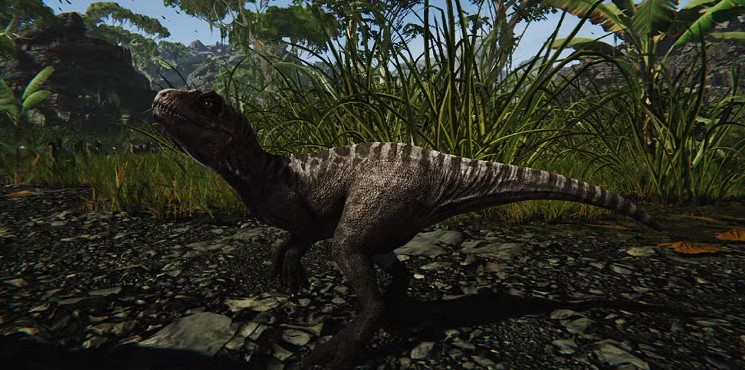
Development of FEROCIOUS began in 2023. In a short time, the project attracted audience attention and accumulated over 300,000 Steam wishlist additions. This was fueled by trailers that portrayed the game as a dynamic shooter set in a tropical archipelago with dinosaurs and destructible environments. However, the release version met with mixed reviews: the gap between the demos and the actual quality was noticeable. In this review, we’ll discuss not only the game itself, but also the controversial nature of indie developers with big ambitions and grandiose claims, but no real development experience.
“Prehistoric” level of optimization
FEROCIOUS was developed in Unity, and this is evident in the visual artifacts and overall level structure. A significant portion of the models, textures, and special effects were taken from free libraries, which directly impacts the style, quality, and unnaturalness of the environments. This decision can also be considered the reason why the final image is so significantly inferior to the trailers.
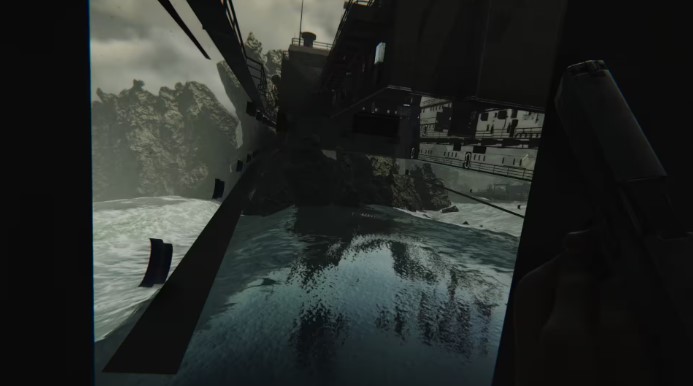
The locations are assembled with numerous holes in the textures. For example, in the coastal area, you can swim to a ship and see that there’s no deck, no side, or anything else inside. And on rocky outcrops, there are trees hanging in midair, as well as empty spaces beyond them. The player is clearly not supposed to enter such areas, but the developers simply didn’t install invisible barriers that would prevent us from passing through.
The situation is exacerbated by constant object loading. Vegetation, rocks, buildings, and even enemies are constantly loading during gameplay. There’s no shader compilation or similar processes, which means you might encounter blurry textures and enemies materializing out of thin air during your playthrough.
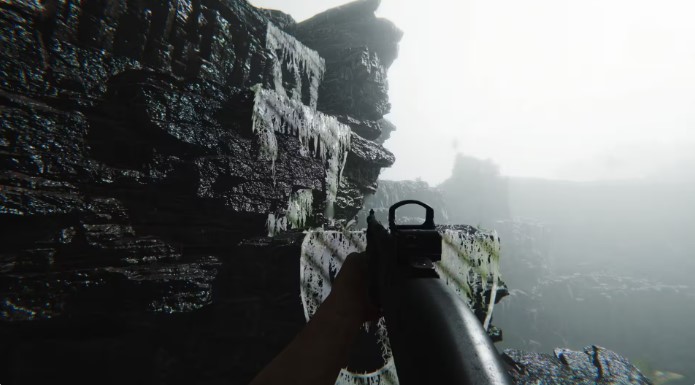
The most problematic element is the lighting. The sources are extremely inconsistent, creating harsh, contrasting glare. In caves, on the contrary, the terrain is poorly legible: shadows are muddy, contrast is blurred, and objects lose their outlines. The backlighting of interactive points deserves special attention. It’s too aggressive and clashes with the overall color palette. And, unlike the yellow paint, it can’t be turned off.
Graphic settings are kept to a minimum. They don’t allow for flexible image quality control or adjustments to lighting and shadows. The player is limited to a narrow range of quality options. Despite all these drawbacks, the game places increased demands on the system. The load on the graphics card and processor is significantly higher than expected for such a smooth image—there’s no hint of optimization here. The longer you play, the worse FEROCIOUS will perform.
Surprisingly, you can report all these issues and bugs. There’s a large “report a bug” button in the game menu. Clicking it will redirect you to the developers’ website with a form where you can describe the bug in detail and attach screenshots and video evidence. On the one hand, this is a very responsible and responsible approach to a debut project. On the other, the prominent location of the button suggests that the developers were aware from the start that the product they were releasing was still in its infancy.
A living, but not living, open world
FEROCIOUS features five open locations available for free exploration. However, their content suffers greatly. The maps appear expansive, but they are based on outposts that must be cleared to advance the story. This is the foundation of the entire gameplay: you move from one camp to the next, eliminating everyone in your path.
There’s little optional content. Exploration boils down to finding tombs and temples, which serve as a source of money and collectible dinosaur figurines. These locations feature unique mechanics, have no impact on the plot, and offer no new opportunities for the protagonist. The main problem with collecting valuables is that they always disappear underground—the rewards must be either scavenged pixel by pixel or left untouched.
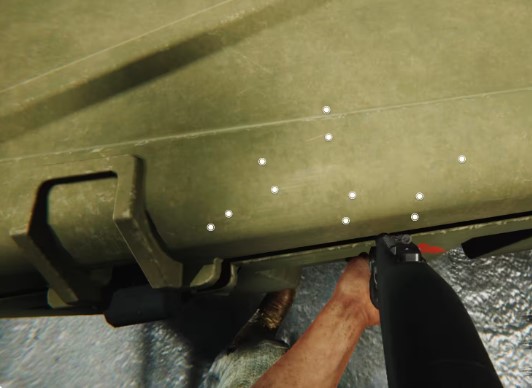
The level structure regularly forces players to backtrack. After completing a task, the player is forced to travel across the entire map to pursue a new quest or unlock a new path. New routes rarely appear, and previously visited outposts may be repopulated with new garrisons, prolonging progress.
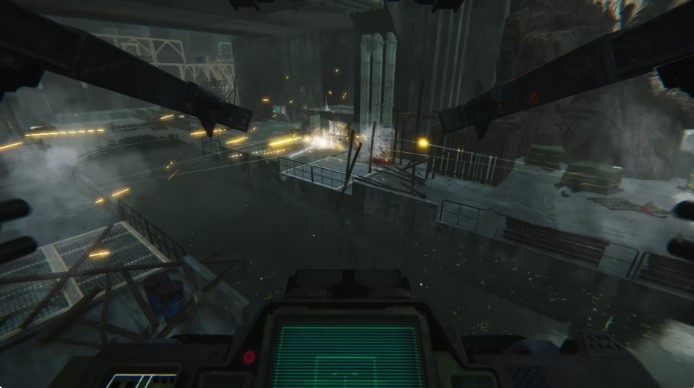
The game features both basic running with jumping and sliding, as well as specific points for ascending and descending: ziplines and vines on cliffs. These objects will always glow, indicating that they can be used. Another option for movement is vehicles, available in three types: a car, a boat, and a combat robot. However, all three have their drawbacks: the car suffers from broken physics—it can fly into the air over a small bump, but doesn’t react at all when it hits objects in its path. The kayak has terrible turning mechanics, and the robot’s built-in turrets are impossible to aim.
Gameplay according to the Ubisoft formula
Combat centers on shootouts with fighters from Manifest, a local evil corporation. Formally, the system includes all the usual gameplay elements: firearms, melee attacks, cover, environmental interaction, and stealth mechanics. However, the quality of execution is extremely poor.
Enemies have a very narrow field of view, causing them to react strangely to threats. They notice corpses but take no action to locate the intruder. In most cases, bodies serve as excellent bait for nearby enemies. When it comes to open combat, they behave no better: some cling to the only cover, others shoot at the player’s last known position, and still others run to raise the alarm.
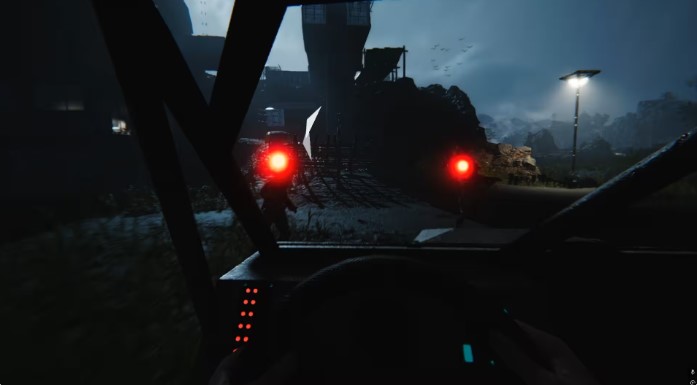
But the strangest thing about the human enemies is the presence of a red flashlight attached to each one’s head. Its glow immediately reveals the owner’s location. On the one hand, this helps spot the target in such a blurry and dirty picture. On the other, this approach explains the developers’ laziness in creating the environment: it’s easier to mark enemies with flashlights than to create proper lighting and locations.
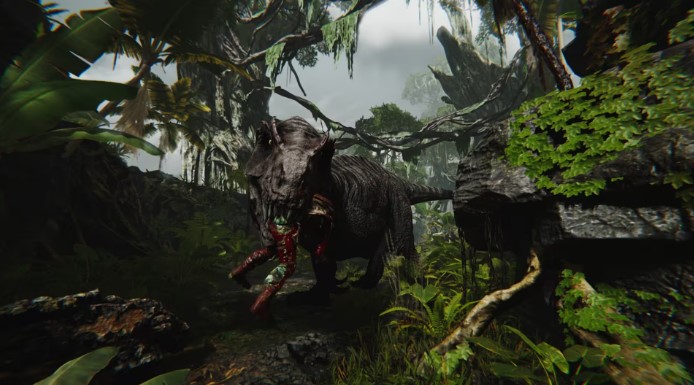
The situation with hostile fauna and wildlife is even more dire. Despite FEROCIOUS being heavily promoted as a dinosaur game, there aren’t many of them. There are three hostile species in total, plus giant ants and crabs. That’s where the list ends. None of the creatures have unique behavior patterns or mechanics—all creatures attack in the same way and don’t require any hunting tactics.
The main marketing hook—large dinosaurs—is less well implemented than the others. They don’t seem like a threat. On the contrary, they become allies! They feature in exactly two episodes, and in both, you’ll command them. For this, the game offers a special device for interacting with the dinosaurs. Another use for the gadget involves opening locked doors in tombs. To do this, you need to take control of the smallest representatives of the fauna and command them to operate levers. That’s where all the puzzles end.
The arsenal in FEROCIOUS isn’t particularly diverse. There are only about a dozen types of weapons. Basic weapon customization is also present. You can attach a silencer, scope, and laser sight. However, there’s no practical difference between the barrels. Any weapon will feel unnatural in the player’s hands: visual recoil is strong, but the bullets themselves always fly accurately. It’s worth noting the strange behavior of grenades and explosive barrels—they deal damage through cover and obstacles, which is effective against both the enemy and yourself.
Another important gameplay mechanic is the ability to craft items and gather resources. The player collects various natural resources and interacts with a menu-like notepad to create useful items, such as first aid kits, ammo pouches, and minor upgrades. The resource gathering process is also slowed down by animations.
The trading mechanics are implemented in a most bizarre way. Each level contains a store where the player can purchase any weapon available in the game. While this mechanic seems understandable at first glance, it has a number of drawbacks: the stores are located in enemy outposts and are almost always locked. To get inside, you need to ask a guard for a key. Secondly, there’s no merchant in these rooms. The player enters an empty room, sees loot, and is forced to hand over money to nothing in order to take only the bare essentials.
The most frustrating thing is that you won’t report these shortcomings to support. This isn’t a bug or a system error, but the true vision of the game designers. Fixing these flaws will take even more time than fixing the technical state of the game. Therefore, if the developers respond to criticism, they’ll simply promise not to repeat such mistakes in the future.
Diagnosis
FEROCIOUS, despite two years of development and its status as a single-player story-driven project, was released in an extremely rough state. The game lacks a cohesive approach in both its level structure and game design: locations are constructed with holes and require constant running back and forth, and the gameplay is repetitive and feels stale. The focus on dinosaurs doesn’t work as advertised at all.
The plot serves as a formal placeholder, serving only as an excuse for the systematic destruction of corporate outposts without offering a full-fledged narrative. Even with a discounted price of 720 rubles, the game doesn’t pay for itself.
As a result, 300,000 gullible gamers received a weak Unity knockoff instead of a quality project in the spirit of Dino Crisis or Far Cry. Avoid!